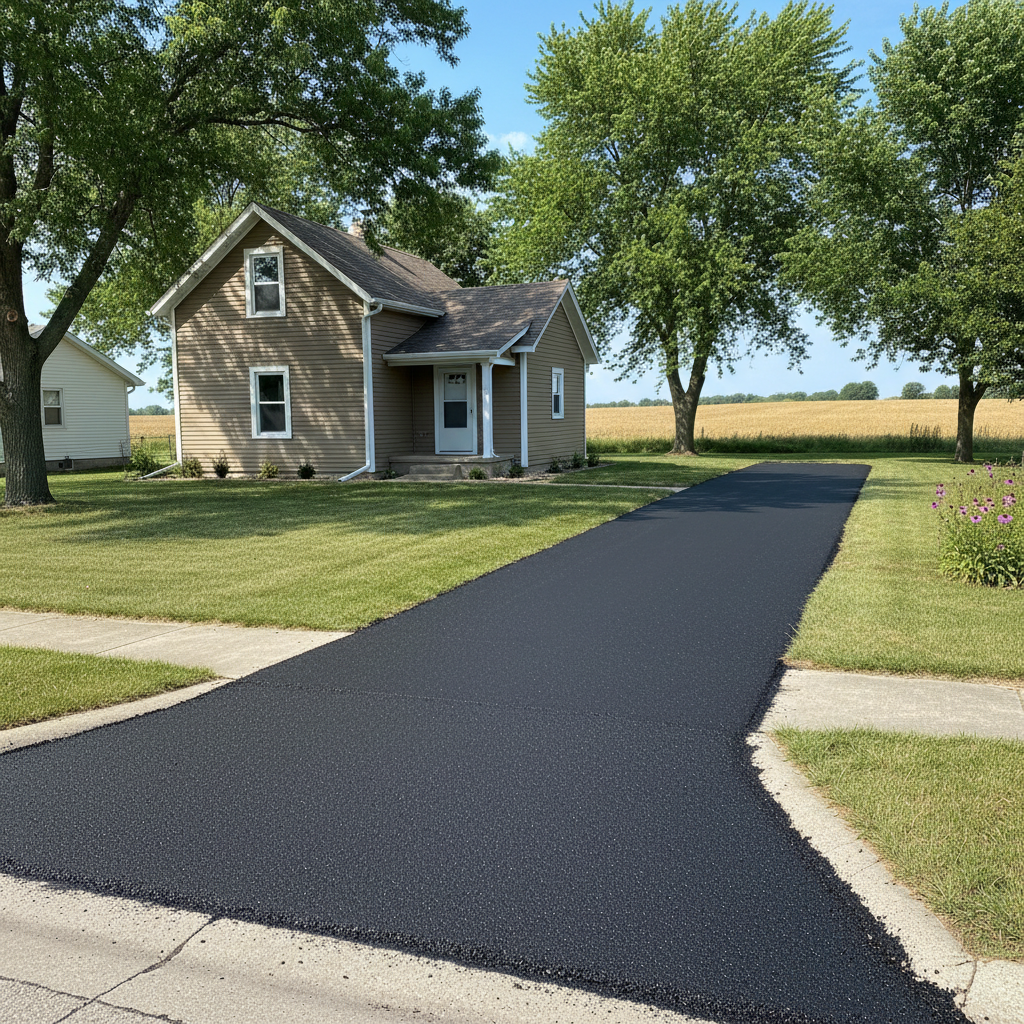
Alright, let's get straight to it. You're probably wondering what a new asphalt driveway will cost you here in Clearwater. It's not a small investment, and I get that you want to know exactly what you're paying for. I've been doing this for a long time, and I've seen all kinds of projects, from small home driveways to big commercial parking lots.
There's no single price tag for a driveway, but I can give you a really good idea of what drives the cost and what to expect when you get a quote.
What Makes Driveway Paving More or Less Expensive?
A few big things really move the needle on cost. It's not just about square footage, though that's a huge part of it, obviously.
- Size & Shape: This one's a no-brainer. A bigger driveway uses more material and takes more time. But also, a really curvy or irregular-shaped driveway needs more handwork and specialized equipment time than a simple rectangle.
- Existing Surface & Prep Work: This is probably the biggest variable, honestly. Are we just putting a new layer over an existing, stable asphalt driveway? Or are we tearing out old concrete, gravel, or a completely failed asphalt surface? Digging out and hauling away old material, then grading and compacting a new sub-base, takes a lot more labor and equipment. If your property has a lot of clay soil, like we see in some of the older parts of town near the river, we might need to add extra base material to ensure stability. That adds to the cost.
- Asphalt Thickness: Most residential driveways around here get 2-3 inches of compacted asphalt. If you've got heavy trucks or RVs constantly on your driveway, you might need 4 inches for durability, which means more material and a higher price.
- Accessibility: Can our heavy equipment easily get to the work area? If we're hauling material a long way or working in a tight spot, that adds time and labor.
- Drainage Needs: Good drainage is crucial. If your property slopes poorly and we need to install culverts, catch basins, or extensive grading to prevent water pooling, that's an additional cost. But it's a necessary one to protect your investment.
- Edging & Aprons: Are we tying into a city street, a concrete apron, or just feathering the edge? Sometimes, you might want concrete curbing or pavers along the edge for a finished look, which is extra.
Typical Cost Ranges for Asphalt Driveways in Clearwater
Okay, let's talk numbers. Remember, these are general ranges, and your specific project could fall outside of them. But this should give you a solid ballpark.
For a standard residential asphalt driveway in Clearwater, you're generally looking at $3.00 to $7.00 per square foot. That's for a complete job, including proper grading, a good aggregate base, and 2-3 inches of compacted asphalt.
- Basic Overlay (if existing surface is good): If your current asphalt is in decent shape and just needs a fresh top layer (usually 1.5-2 inches), you might be closer to the $2.00-$3.50 per square foot range. This is less common for full driveways but can happen sometimes.
- New Installation (standard prep): For a new driveway where we're grading and putting down a good base, then 2-3 inches of asphalt, expect $3.50-$5.50 per square foot. This covers most typical residential projects.
- Complex or Heavy-Duty: If we're doing extensive excavation, adding extra base for poor soil, or laying down 4+ inches of asphalt for heavy use, you could see prices climb to $5.50-$7.00+ per square foot.
So, for a typical 16x40 foot (640 sq ft) driveway, you might be looking at anywhere from around $2,240 to $4,480 for a standard new installation. A larger 20x60 foot (1200 sq ft) driveway could be $4,200 to $6,600. These are just examples to help you visualize the cost.
What Should Be Included in Your Quote?
When you get a quote from All Star Asphalt Inc, or any reputable contractor, it should be clear. Don't settle for a one-line estimate.
- Site Preparation: This means grading, excavation, removal of old material, and proper compaction of the subgrade.
- Base Material: The type and depth of the aggregate base (e.g., 6 inches of compacted crushed rock).
- Asphalt Layers: The number of asphalt layers and their compacted thickness (e.g., 2 inches of binder course, 2 inches of surface course).
- Drainage: Any specific drainage solutions like swales, culverts, or catch basins.
- Edging: How the edges of the driveway will be finished.
- Cleanup: What they'll do to leave your property tidy after the job.
- Warranty: A clear statement of the warranty on materials and workmanship.
How to Avoid Overpaying for Your Driveway
You don't want to get ripped off, and I don't want to see good folks in Clearwater get taken advantage of. Here's my advice:
- Get Multiple Quotes: Always get at least three detailed quotes. This helps you compare apples to apples and understand the market rate.
- Check References & Reviews: A good contractor will have happy customers. Ask for local references or check online reviews.
- Don't Rush: If someone pressures you for an immediate decision or offers a deal that's